🌻 Task 3 – Answering questions – Individual questions.
Chapter Contents.

Pages in this Chapter
What are the narratives behind a specific link?

It is important to frequently return to the original quotes associated with each factor or link to understand how different stakeholders interpret and talk about key concepts. This can be done in Causal Map by clicking on a link in the interactive map, or by printing out quotes for a particular filter (e.g. just for a single bundle of links) with additional context and metadata.

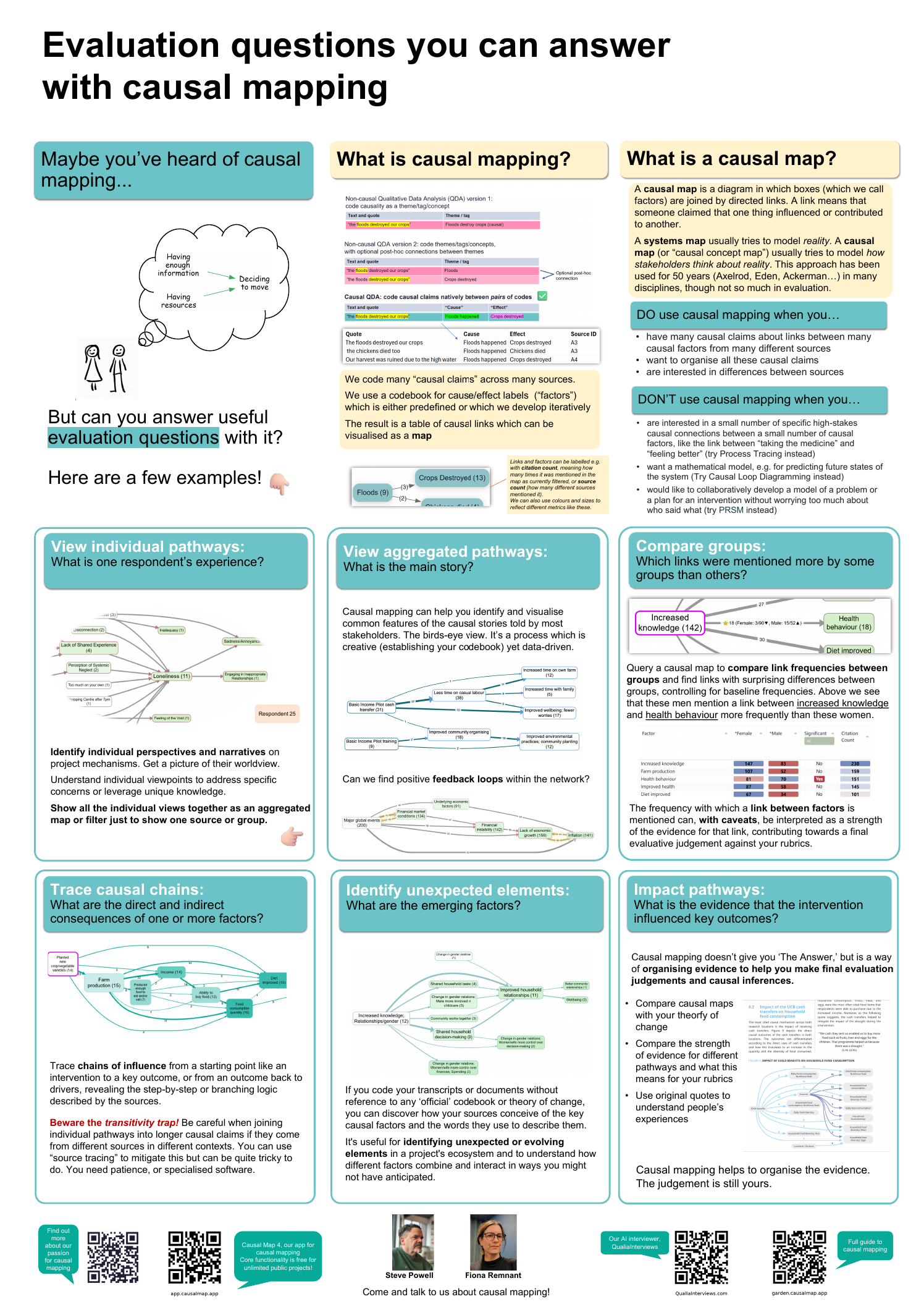
What are the emerging or unexpected factors?

One way to do identify emerging or unexpected factors is to use the elements from your theory of change as your codebook while coding and only adding other elements when necessary, making a note of these additional elements.

Does the evidence support your theory of change?

One way to do this is to use the elements from your theory of change as your codebook and only add other elements when necessary. Validated pathways of change (by showing which mechanisms are observed on the ground) and find gaps where expected pathways might be missing or where stakeholders list elements were not anticipated in the theory of change?

Assessing systems change

One of the most exciting applications of causal mapping is to assess change over time within a system. If we apply a systematic approach to coding (using blindfolded manual coding or AI-supported coding) we can compare the frequencies with which links or factors are mentioned over time. This becomes particularly interesting when applying inductive coding, so that new and emerging phenomena can be included into the codebook. Re-applying new codes to previously coded data would be very tedious with manual coding but is easy to do with AI-supported coding: [[860 Transforms Filters -- Soft Recode with Magnetic Labels]]

Names of tables and fields

We can think of a causal map as a database consisting of two tables, the links table and the sources table. We don't need to have a separate table for the factors because the factors can be derived from the links table.

Counting and comparing influences

How much evidence is there for the influence of our intervention on a valued outcome? Is that a lot? Can we compare these numbers across pathways?

Combining questions

Causal mapping gets really useful when you start to combine the different questions you might want to ask in order to answer more sophisticated questions. We can think of many of the techniques as filters which filter the view in a particular way. Using multiple filters allows you to build up an answer to a question. Usually, order matters.